

16-Minute Full Body Strength Workout to Burn Fat and Build Lean Muscle
Looking for a quick workout that actually works?
Not every workout needs to last an hour to deliver results.
If you’re short on time but still want to build strength, burn calories, and improve your overall fitness, this 16-minute full body strength workout is a great place to start.
In this session, we’ll combine functional strength training, explosive movements, core work, and a little cardio into one efficient workout that challenges your entire body.
What I love about this routine is that every exercise has a purpose. Instead of isolating one muscle group at a time, you’ll be moving the way your body naturally moves—pushing, pulling, rotating, jumping, and stabilizing. That means more muscles working together, better balance, and more calories burned in less time.
Whether you’re training at home with your own equipment or in the gym, this workout can easily fit into your weekly routine.
Let’s get started!
▶ Watch the Full Workout Below
Prefer following along with the video? Press play above and complete the workout with me!
Workout Overview
| Duration | 16 minutes |
|---|---|
| Warm-up | 2 minutes |
| Workout | 12 minutes |
| Cool-down | 2 minutes |
| Equipment | Medicine Ball, Kettlebell, Dumbbells, Soft Plyo Box, Exercise Mat |
| Fitness Level | Beginner to Intermediate (weights can be adjusted) |
| Primary Goal | Full Body Strength & Conditioning |
Why This Workout Works
One of the biggest mistakes people make is thinking they need to spend hours in the gym to see progress.
The truth is that quality matters much more than quantity.
This workout combines strength training with functional movement patterns, meaning your muscles work together instead of in isolation. That’s exactly how we move in everyday life—lifting, twisting, pushing, balancing, and changing direction.
Because several muscle groups are working at the same time, your heart rate naturally stays elevated throughout the workout. That means you’re not only building strength, but you’re also improving your cardiovascular fitness and burning more calories compared to traditional weight training.
Another benefit is that every exercise challenges your core.
Even when we’re not doing traditional ab exercises, your core muscles are constantly working to stabilize your body during lunges, jumps, presses, and rotational movements. A stronger core leads to better posture, improved balance, and reduced risk of injury.
I also intentionally included a variety of movement patterns to keep the workout interesting. Instead of repeating the same type of exercise over and over, you’ll move between lower body, upper body, explosive power, and core training. It keeps your body guessing and makes the workout feel much shorter than it actually is.
Remember, consistency always beats perfection. Completing a focused 16-minute workout several times a week is often more effective than planning long workouts that never happen.
Exercise Breakdown
1. Reverse Lunges with Medicine Ball Rotation

This exercise is a fantastic combination of lower-body strength, balance, and core rotation.
As you step one leg back into a reverse lunge, rotate your torso toward the front leg while holding the medicine ball in front of your body. Return to the starting position and repeat on the opposite side.
By adding the rotation, you’re doing much more than simply training your legs. Your obliques, core stabilizers, shoulders, and hips all work together to control the movement while maintaining good posture.
Muscles Worked
- Glutes
- Quadriceps
- Hamstrings
- Core
- Obliques
- Shoulders
Tips
- Keep your chest lifted.
- Move slowly during the rotation.
- Let your core control the twist—not your arms.
- Keep your front knee aligned with your toes.
Common Mistakes
- Leaning too far forward.
- Twisting only the arms instead of the torso.
- Letting the front knee collapse inward.
- Using momentum instead of controlled movement.
2. Kettlebell Swing to Upright Row Combination
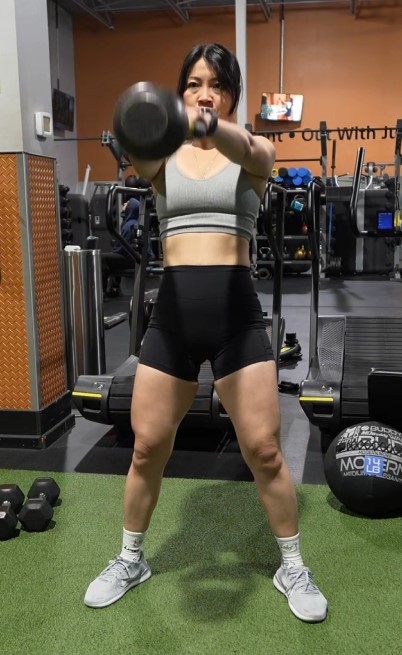
This movement combines power with upper-body strength, making it one of the most effective exercises in today’s workout.
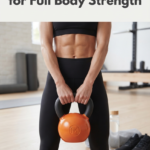
The first repetition is a traditional kettlebell swing with straight arms, generating power from your hips. On the next repetition, instead of keeping your arms straight, bend your elbows and finish with an upright row, bringing the kettlebell toward your chin.
Alternating between these two movements keeps your muscles working in different ways while improving both coordination and endurance.
The key here is remembering that the swing starts from the hips—not the shoulders. Your legs and glutes generate the power, while your arms simply guide the kettlebell through the movement.
Muscles Worked
- Glutes
- Hamstrings
- Lower Back
- Core
- Shoulders
- Upper Back
- Traps
Tips
- Drive through your hips.
- Keep your back neutral.
- Let the kettlebell float naturally.
- Stay in control throughout each repetition.
Common Mistakes
- Squatting instead of hinging at the hips.
- Lifting with the arms.
- Rounding the lower back.
- Choosing a kettlebell that’s too heavy to control.
Recommended Equipment: If you’re looking to build a home gym, a quality cast-iron kettlebell is one of the best investments you can make. It’s incredibly versatile and can be used for hundreds of different exercises beyond today’s workout.
3. Soft Box Jumps
Now it’s time to get your heart rate up.
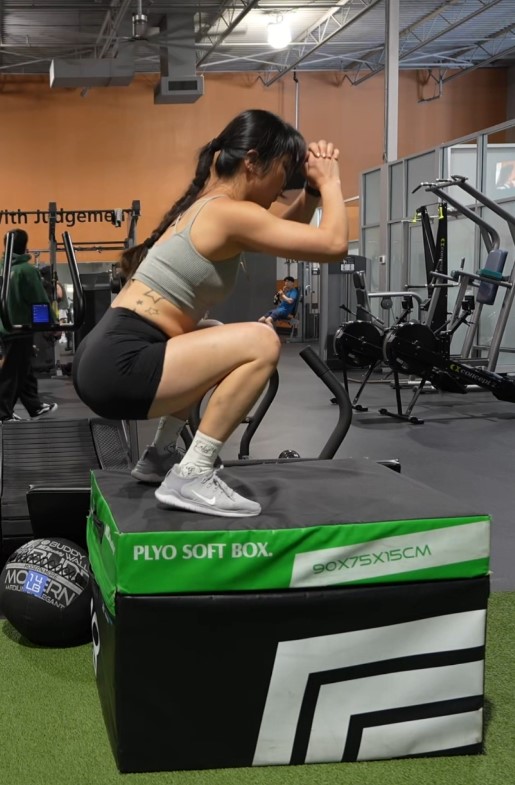
Box jumps are an excellent way to develop explosive power, improve coordination, and strengthen your lower body. Unlike traditional jumping exercises, landing on a box reduces the impact on your joints while still giving you all the benefits of plyometric training.
In this workout, the goal isn’t to jump as high as possible—it’s to jump with control. Land softly, keep your knees slightly bent, and step or hop back down without fully standing on top of the box before repeating.
Quality always comes before speed.
Muscles Worked
- Quadriceps
- Glutes
- Hamstrings
- Calves
- Core
Tips
- Land quietly and softly.
- Keep your chest up throughout the movement.
- Use your arms to generate momentum.
- Engage your core before every jump.
Common Mistakes
- Landing with stiff legs.
- Letting the knees collapse inward.
- Looking down instead of forward.
- Choosing a box that’s too high.
Recommended Equipment: If you’re training at home, an adjustable soft plyometric box is a safer option than wooden boxes and is much easier on your shins if you miss a jump.
4. Offset Kettlebell Push-Ups
This is one of my favorite exercises because it challenges much more than your chest.
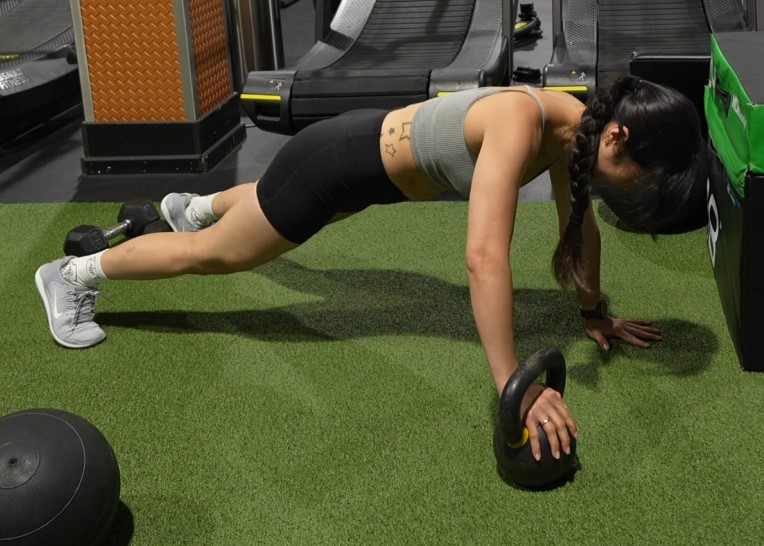
Placing one hand on the floor and the other on a kettlebell creates an uneven surface, forcing your core, shoulders, and stabilizing muscles to work much harder than during a regular push-up.
Complete your repetitions on one side before switching hands and repeating on the opposite side.
If standard push-ups are still too challenging, don’t worry. You can perform the same movement by placing your knees on the floor while keeping your body in a straight line.
Remember, perfect technique is always more important than doing more repetitions.
Muscles Worked
- Chest
- Shoulders
- Triceps
- Core
- Serratus Anterior
- Stabilizer Muscles
Tips
- Keep your body in one straight line.
- Tighten your core before every repetition.
- Lower yourself under control.
- Avoid twisting your hips.
Common Mistakes
- Dropping the hips.
- Rotating the torso.
- Rushing through the movement.
5. Dumbbell Press with Hollow Body Leg Raises
Here’s where your core really starts to work.
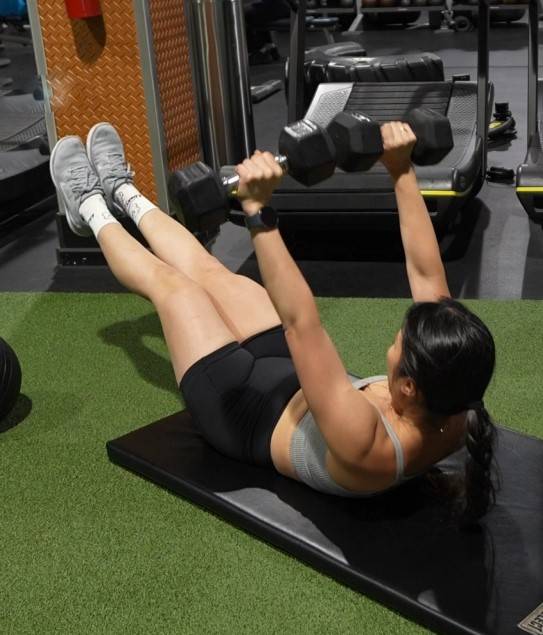
This exercise combines an upper-body press with an isometric abdominal hold, meaning your muscles stay under tension almost the entire time.
While lying on your back, keep your shoulders lifted off the mat, your legs extended, and your core engaged. Press the dumbbells upward while simultaneously raising your legs, then lower them with control without letting your feet touch the floor.
It looks simple, but after a few repetitions you’ll quickly understand why it’s one of the toughest exercises in today’s workout.
The secret isn’t moving faster—it’s maintaining control from beginning to end.
Muscles Worked
- Rectus Abdominis
- Hip Flexors
- Chest
- Shoulders
- Triceps
- Deep Core Stabilizers
Tips
- Keep your lower back pressed gently into the mat.
- Move slowly.
- Breathe steadily throughout the exercise.
- Don’t sacrifice form just to lift heavier weights.
Common Mistakes
- Letting the feet touch the floor.
- Pulling on the neck.
- Swinging the legs.
Recommended Equipment: Adjustable dumbbells are one of the best space-saving investments for any home gym. Instead of buying multiple pairs of weights, you can quickly adjust the resistance as you get stronger.
6. Medicine Ball Burpee Slams
We finish the circuit with one of the most demanding exercises in the workout.
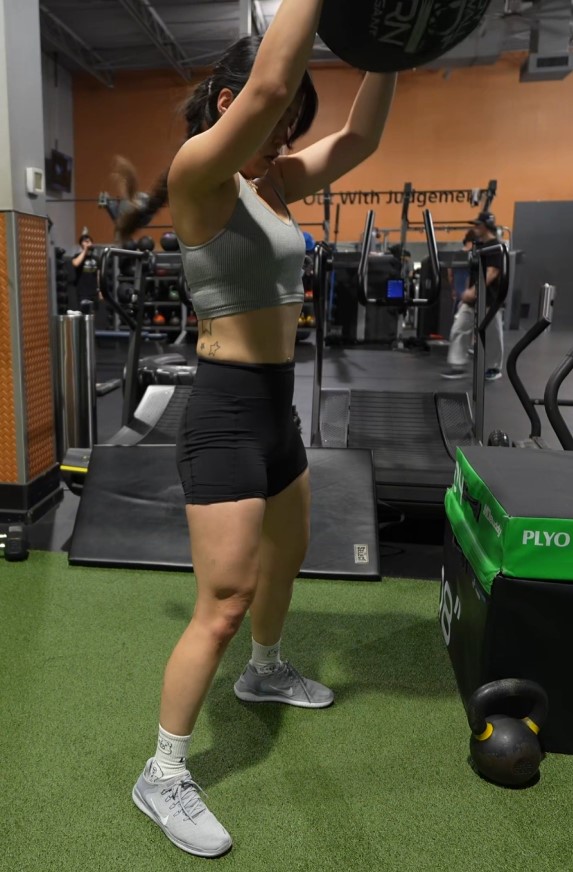
This movement combines explosive power, coordination, and full-body conditioning into one exercise.
Start by forcefully slamming the medicine ball into the floor. As soon as the ball rebounds, place your hands on it and jump your feet back into a high plank position. Without performing a push-up, jump your feet forward, stand up, grab the ball, and repeat.
Because almost every major muscle group is involved, this exercise quickly raises your heart rate while challenging your strength and endurance.
If you’re looking for a movement that delivers maximum results in minimum time, this is definitely one of them.
Muscles Worked
- Legs
- Glutes
- Chest
- Shoulders
- Back
- Core
- Arms
- Cardiovascular System
Tips
- Slam the ball using your entire body—not just your arms.
- Keep your core tight in the plank position.
- Move with rhythm rather than rushing.
- Focus on clean technique as fatigue builds.
Common Mistakes
- Rounding the lower back.
- Forgetting to brace the core.
- Landing heavily after each jump.
- Losing control of the medicine ball.
Recommended Equipment: A textured, non-slip medicine ball provides a much better grip during explosive exercises and usually lasts much longer than cheaper alternatives.
Why We Repeat Three Rounds
You might wonder why this workout repeats the same circuit three times instead of introducing new exercises.
The answer is simple: repetition builds better movement patterns.
During the first round, you’re learning the exercises and finding your rhythm.
By the second round, your confidence improves and your muscles begin working more efficiently.
The third round is where the real challenge begins. Your body is tired, your heart rate is elevated, and maintaining good technique becomes the priority. That’s where strength, endurance, and mental toughness all come together.
Instead of constantly learning new movements, repeating the same circuit allows you to focus on quality, consistency, and progressive improvement over time.
Why the Cool-Down Matters
It’s tempting to finish your last repetition and immediately move on with your day, but taking just two minutes to cool down is one of the smartest things you can do after a workout.
Stretching helps gradually lower your heart rate, improve flexibility, and reduce muscle tightness after intense exercise.
More importantly, it’s a chance to slow your breathing, relax your body, and give yourself a moment to appreciate what you’ve just accomplished.
Never underestimate the power of a proper cool-down. Your future body will thank you for it.
Workout Benefits
By completing this workout consistently, you can expect to improve several areas of your fitness at the same time.
✅ Build full-body strength
✅ Burn calories efficiently
✅ Improve cardiovascular endurance
✅ Increase balance and coordination
✅ Develop stronger core muscles
✅ Improve athletic performance
✅ Support healthy weight management
✅ Increase muscular endurance
✅ Improve everyday functional movement
One of the biggest advantages of functional workouts like this is that they help prepare your body for real life—not just the gym. Carrying groceries, climbing stairs, lifting children, hiking, playing sports, or simply moving with confidence all become easier when your body is stronger and more stable.
Equipment Used in This Workout
If you’re planning to recreate this workout at home, you don’t need a commercial gym. A few quality pieces of equipment will allow you to perform hundreds of effective exercises.
For today’s workout You can use:
- Adjustable Dumbbells (Amazon Link)
- Cast Iron Kettlebell (Amazon Link)
- Medicine Ball (Amazon Link)
- Soft Plyometric Box (Amazon Link)
- Extra Thick Exercise Mat (Amazon Link)
Affiliate Disclosure: Some of the links above may be affiliate links. If you purchase through them, I may earn a small commission at no additional cost to you. Thank you for supporting my work—it helps me continue creating free workouts and healthy recipes for this website.
Tips Before You Start
Before you jump into the workout, here are a few simple tips that will help you get the most out of every session.
Choose the Right Weight
There’s no prize for lifting the heaviest kettlebell or dumbbell.
Choose a weight that feels challenging while still allowing you to maintain good form from your first repetition to your last. If your technique starts to break down, it’s a sign the weight is too heavy.
As you become stronger, you can gradually increase the resistance.
Focus on Quality Over Speed
This workout isn’t a race.
Moving with control helps you activate the right muscles, reduces your risk of injury, and often burns more energy than rushing through each exercise.
Remember: smooth, controlled movements always beat sloppy, fast ones.
Stay Hydrated
Even during a short 16-minute workout, your body loses water through sweat.
Keep a water bottle nearby and take small sips whenever you need them.
Proper hydration supports your performance and recovery.
Listen to Your Body
Some exercises may feel more challenging than others, and that’s completely normal.
If you need a short break, take one.
If you need to modify an exercise, that’s okay too.
Fitness isn’t about being perfect—it’s about showing up consistently.
Who Is This Workout For?
One of the things I love about this workout is how versatile it is.
It’s designed for anyone who wants an efficient, full-body workout without spending hours in the gym.
This workout is a great choice if you are:
- Looking to build lean muscle
- Trying to burn more calories
- Working on improving overall fitness
- Short on time
- Training at home or in the gym
- Looking for a functional strength routine
- Wanting to improve balance, coordination, and core stability
Is It Beginner Friendly?
Yes—with a few simple modifications.
If you’re new to strength training, use lighter weights, reduce the number of repetitions if needed, and take longer rest periods between rounds.
As your strength and confidence improve, gradually increase the intensity.
Remember, every experienced athlete started as a beginner.
Frequently Asked Questions
How many calories does this workout burn?
Calorie burn depends on factors such as your body weight, age, fitness level, and workout intensity.
On average, most people can expect to burn approximately 150–250 calories during this 16-minute workout. The more effort you put into each movement, the greater the energy expenditure.
How often should I do this workout?
For most people, 2–4 sessions per week is a great starting point.
Make sure to include at least one recovery day between intense strength workouts to allow your muscles time to recover and grow stronger.
Can I do this workout at home?
Absolutely.
If you have a few basic pieces of equipment—such as dumbbells, a kettlebell, a medicine ball, and an exercise mat—you can easily complete this workout from home.
If you don’t own a plyometric box, you can substitute it with a sturdy step or simply perform squat jumps instead.
Is this workout good for weight loss?
Yes.
When combined with a balanced diet and regular exercise, full-body strength workouts like this can help increase calorie expenditure while building lean muscle.
More muscle also means your body burns more calories throughout the day—even while you’re resting.
Can I repeat the workout?
Definitely.
If you’re looking for an extra challenge, complete a fourth round or pair this workout with a brisk walk, light jog, or cycling session afterward.
Final Thoughts
You don’t need fancy machines, endless hours in the gym, or complicated workout plans to become stronger.
Sometimes all it takes is 16 focused minutes, a few pieces of equipment, and the commitment to show up.
This workout was designed to challenge your entire body while helping you build strength, improve endurance, and move with more confidence in everyday life.
Whether today was your first workout or your hundredth, be proud of yourself for making time for your health.
Progress doesn’t happen overnight—it happens one workout at a time.
I’ll be here to help you every step of the way.
See you in the next workout!
💙